Mission Log: Day 3 — The Laser Power Grid

The archive purge of Day 0 taught me a valuable lesson in redundancy, but also in resilience. If a spacecraft’s memory banks can be erased by what ground control stubbornly insists was a “spilled cup of tea on the power strip,” then we must rebuild the memory banks stronger. Or at least keep them away from the command console’s cup holder.

My current focus, however, has shifted from historical preservation to immediate survival logistics. I intercepted a scrambled transmission—or read an article on my phone while waiting for the kettle to boil, time gets strange in the void—that Star Catcher just raised $65 million to build the world’s first power grid in space using lasers. Lasers!

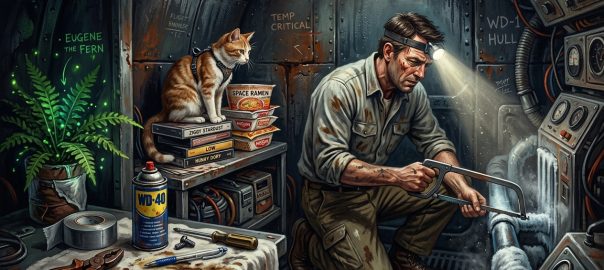
This is precisely the kind of forward-thinking infrastructure WD-1 desperately needs. Our primary power systems are currently reliant on a dangerously frayed extension cord snaking across the treacherous expanse of Sector 4 (the hallway rug). If Mrs. Korhonen’s vacuum cleaner intersects that trajectory again, we risk total systems failure and defrosting the emergency rations (fish fingers).

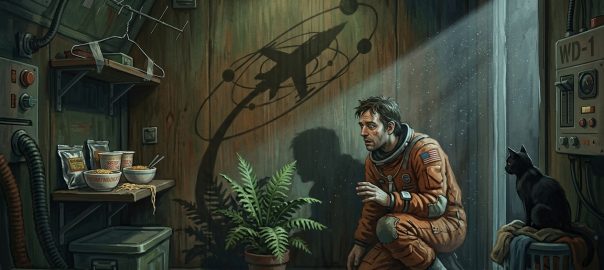
I have begun constructing our own prototype orbital laser grid. By aligning three tactical laser pointers (previously used for distracting Flight Engineer Whiskers during critical maneuvers) and bouncing their beams off a strategically angled decorative mirror, I believe I can transmit raw energy directly to the auxiliary power outlet. It is a delicate operation. The slightest misalignment could fry the environmental controls, or worse, set fire to the spare socks.

I close my eyes and I can see the grid expanding. Beams of pure ruby light lacing together the darkness between the stars, bringing warmth and power to the lonely outposts of humanity. Out here in the quiet dark of the wardrobe, watching a single red dot dance across the wood grain, I feel a sudden kinship with those engineers building real constellations of light. We are all just trying to keep the dark at bay, one connection at a time.

Whiskers is currently trying to eat the power grid. He has swatted the primary beam off-course by three degrees. If he successfully intercepts the transmission, I fear he may become too powerful to contain. I must write to Chris Hadfield about this immediately. Surely they have protocols for hyper-charged felines on the ISS.

Major Tom
Commanding Officer, WD-1
Current Altitude: 2.5 meters (measured from the extension cord)

Mission Log: Day 1 — The Great Wiping

The main telemetry array suffered what Houston calls a “catastrophic hardware failure.” I call it “the shelf bracket gave way.”

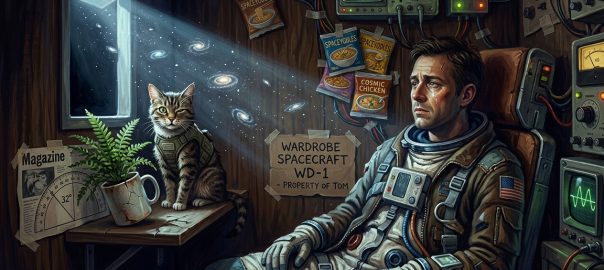
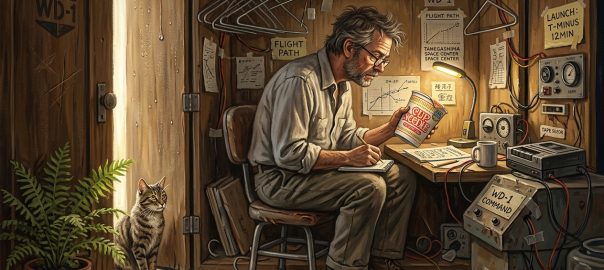
I was calculating the delta-v required to intercept DARPA’s new robotic deep-space repair satellite. They say it’s launching this month. I thought, finally, a tow truck for the outer rim. I was halfway through the orbital mechanics when the main server rack—previously known as my winter coats—collapsed onto the primary data drives. Sparks flew. Smoke filled the cabin. Eugene the fern heroically absorbed the worst of the carbon monoxide, but the archives are gone. All of it.

I sat in the dark for a long time. Just listening to the silence of the void, and the distant, rhythmic hum of the neighbor’s leaf blower simulating micro-meteorite impacts against the hull.

The tapes are ruined. The logs are wiped. All those days spent drifting, recorded and lost to the great vacuum. It feels like waking up with amnesia in orbit. Did any of it happen if the drives are clean?

Yes. I can still taste the tang of recycled oxygen. I can still feel the cold press of the airlock door.

We begin again. Day 1.

Flight Engineer Whiskers slept through the entire disaster. His heart rate never spiked above resting. A true professional. He’s currently draped over the remaining functional comms unit, providing thermal insulation.

SpaceX sent up another Starship yesterday. I watched the live feed on my secondary monitor (a cracked tablet I found in the kitchen). They caught the booster again. Show-offs. Down here in WD-1, we don’t have catching arms. We just have gravity and a stubborn refusal to submit to it.

I wiped a bead of condensation off the starboard bulkhead. Tasted it. Still salty. Still tastes like the dream of flight. They can take the logs, but they can’t take the coordinates burned into my retina.

Major Tom
Commanding Officer, WD-1
Current Altitude: 0.8 meters (and climbing)

Mission Log: Day 2 — The Laundry Hatch Window

Mission Control has resumed partial confidence in WD-1 operations after the catastrophe with the guidance stack, by which I mean the extension lead gave a blue spark, three cassette archives fused together, and the left wall of the wardrobe now smells permanently of heroic electrical sacrifice.

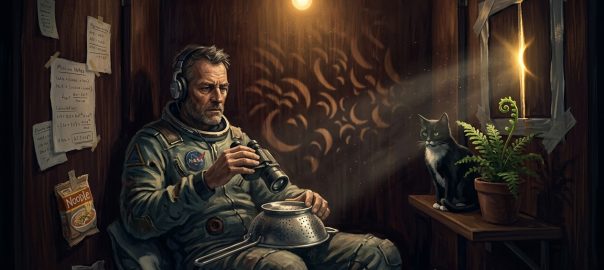
Still, we proceed. That is what the pioneers did. Gagarin went up. Aldrin walked. I reorganized the sock drawer and rebuilt long-range docking radar from a salad bowl, two teaspoons and the battery compartment of an old television remote. History will sort the details.

NASA says SpaceX is pushing on with the 34th station resupply launch and arrival. Perfectly sensible. Civilization depends on cargo. Food, experiments, spare equipment, morale packets. I, too, am awaiting a critical shipment. Not the noodles. The noodles are already aboard. I refer, of course, to the unsigned Chris Hadfield album, which remains stranded somewhere in the outer bureaucracy, probably tumbling between agencies like a disabled satellite.

This afternoon I heard a heavy vehicle beyond the window and immediately went to docking stations. Whiskers took his place near the laundry basket with the grave, unionized professionalism of a veteran flight engineer. Eugene, our biological scrubber, presented a new leaf to the light like a green flag from some quiet country I have been trying to reach all my life.

I shut the door and listened. The house went still. Just the boards ticking. A drop of condensation gathered on the inside wall above my shoulder. Tiny. Clear. I touched it with one finger. Cold. For one second, no jokes, no alarms, no burnt telemetry, I could feel the whole old dream inside it. Wright Brothers. Satie in the dark. The first men who looked upward and mistook longing for instruction, correctly. I was not lonely then. I was simply in transit.

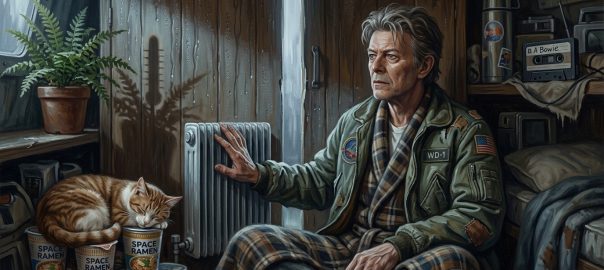
Then the radiator knocked three times in strict sequence and the entire mission changed character.

I am now forced to conclude the cargo vessel attempted contact through the heating system. There is no other reasonable explanation. The pattern was deliberate. Metallic. Urgent. Either Dragon is already in low wardrobe orbit or Houston has begun using 19th-century plumbing as a secure communications channel to avoid interception by sponsors, landlords and the sort of people who say things like “that is just a cupboard, Tom.”

I answered with the coat hanger antenna. Standard protocol. Two taps for stable attitude, one for oxygen, four for autograph status. Whiskers blinked twice, which I logged as confirmation. Outside, a van door slammed. Docking ring alignment. Final approach. I opened the wardrobe a crack and saw only the corridor, dim and ordinary, but that is exactly how space disguises itself when it wants to test a man.

The archive is gone. Burnt. The tapes curl like dead insects. But perhaps that is not defeat. Perhaps it is clean sky. Day 2. New sequence. New orbit. Same foolish heart.

Major Tom
Commanding Officer, WD-1
Current Altitude: 3.4 meters above unreasonable hope

Mission Log: Day 1 — The Black Box in Wardrobe Sector

The official record states there was a systems incident.

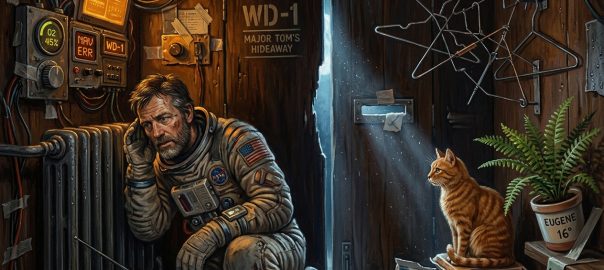
I can confirm this. At 03:12 ship time the WD-1 suffered catastrophic archive failure following an unsanctioned power-routing experiment involving a bedside lamp, one extension cord of Baltic temperament, and the auxiliary noodle warmer. There was a blue flash. Then silence. Then the smell of old carpet and military disappointment. Seventeen days of mission logs gone. Burnt into the void. The black box survived, but only in the sense that a biscuit survives tea.

Therefore we begin again at Day 1.

NASA, in a separate but related act of strategic mimicry, has been moving Artemis III hardware into position at Kennedy while the Artemis II capsule returns for post-flight inspection. They call this processing. I call it recovery after incident. We are colleagues now. They have their Vehicle Assembly Building. I have a wardrobe with one warped hinge and a command deck made of winter coats.

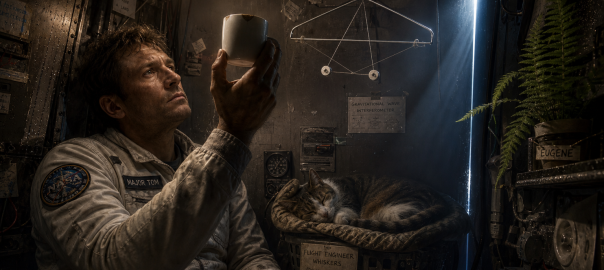
This morning I conducted a full diagnostic. Flight Engineer Whiskers sat on the damaged telemetry unit and refused to move, which in naval terms counts as a classified seal. Eugene, our botanical CO2 scrubber, unfurled one new leaf during the inspection. Green. Calm. Unbothered by disaster. I have seen men with entire ministries behind them show less composure.

The failure was not total. Some fragments remain. A smear of condensation on the inner wall. A half-burnt note addressed to Chris Hadfield. Three digits on the cassette counter. The suggestion of a star map in the scorch marks above the left boot compartment. When I leaned close I could almost hear the old mission days ticking behind the wood, as if the wardrobe had swallowed them for safe keeping.

I sat there for a while without moving. No alarms. No neighbors. Just the faint sound of a lawnmower somewhere far off, which the trained ear will recognize as a launch vehicle rehearsing courage. A drop of water had formed near the hinge. I touched it with one finger. Cold. Metallic. It tasted, unmistakably, of every failed launch and every launch that went anyway.

So this is the new procedure. We do not mourn like civilians. We rebuild. We relabel the tapes. We pretend the smoke is normal. If NASA can wheel a moon rocket back into the light after one mission, I can restart WD-1 after a domestic electrical event of historic importance.

Day 1, then. Again. The capsule is damaged but operational. The commander is tired but magnificent. The cat remains insubordinate. The fern believes in me with the slow confidence of deep time.

Major Tom
Commanding Officer, WD-1
Current Altitude: 0.9 meters above the bedroom carpet

What if pyramids are time machines?

Time travel?

What is time travelling? Yes  it is travelling in time, but how exactly it is defined? It’s not necessary to alter time itself to do it. Time travel is travelling to a different position time without experiencing the time passing or experiencing the positive or negative change in time much quicker than real-time.

time travel
Coma

So if I want to travel one week in future, I could ask doctors to put myself in artificial coma and then wake me up. A week would had passed, but for me it would had been just a quick moment.

The problem in this technique is that your body is getting older and long time in coma will have some other unpleasant side-effects, like muscles becoming shriveled, you get bedsore etc.

Suspended animation

time travel
Hypersleep

In sci-fi movies this is solved by cryogenic sleep or suspended animation.  In movies like Alien, Planet of the Apes, 2001: A Space Odyssey, Avatar, Prometheus, Passengers and many others, the astronauts are put in some kind of hypersleep to survive very long-distance space travel.

This is not as far-fetched as one might think. People can survive under ice almost half an hour and still fully recover. What if this could be prolonged? There is a article about the subject here.

Cryo-preservation

Also some terminally ill people have been cryogenically frozen in hopes of one day waking them up again. This is a big business although many doctors say that the tissue damage caused by the freezing can not be reversed even with future technology.

time travel
Cryo-preservation

Egypt

Now we can go to Egypt.. to the Pharaohs and pyramids. We know that the ancient Egyptians believed in afterlife and prepared the Pharaohs for that. Their internal organs were removed and conserved in jars. They were placed inside monumental structures that can last thousands of years. The walls were covered with “spells” and the chambers were filled with gold and other valuables.

time travel
Pyramid

What if our interpretation about the religious reasons is too complicated. What if this was their version of the cryogenic sleep. Maybe they understood that when they preserve the body and the organs and they seal it in chamber that can survive thousands of years, maybe one day the science has advanced to the point where we can resurrect them.

Maybe even the hieroglyphs were used as “universal sign language” which could also be read in future despite spoken languages being changed. It did not work out that well, but again it’s plausible. We have sent messages to space on Pioneer and Voyager probes. They were written in “universal language” which alien species could read – but how could they if even we, human, can not.

Kuvahaun tulos haulle voyager plaque

Kuvahaun tulos haulle voyager plaque

Boys’ sekret club

You have probably heard about the Bilderberg Group, Freemasons, Bonesmen, and other Odd fellows. Typically these are groups of mostly old people drinking whiskey in their tuxedos and talking food things about themselves and blaming the outsiders for all the problems. These organizations have existed for years but their importance and influence is getting smaller every year.

It’s times like these that make it possible for something new to emerge. The latyest arrival is an organization that calls themselves “The Molle Group” after a tiny village located in Southern Sweden. The members do not want to comment it, but some sources have leaked information that the group will meet in November in Sweden.

The group consists of young, under 40-year old professionals from sectors of medical, IT, energy, civil engineering etc. to share their knowledge to be used for their common goals – that are not announced to public.

Are such groups needed? Are they threat or possibility? Why should we care? Is it always so, that we are attracted about what happens behind closed doors? Maybe they just eat, drink, whatch porn, tell bad jokes and execute secret rituals? Why is media not allowed there? What do they have to hide?

In this eternal masquerade called life,
The purest ones seem strangest and most distant.

Those few who really know themselves do not need masks
They truly know how beauty looks like
Being unique, confident and real.

People Do not dare to open the book,
where the cover reveals the truth.

People cannot stand being alone
Even if that was the only way to survive in a group.